EV Electric Charger Installation in Ontario Canada
first second third Describe your EV charger project Get quotes from verified installers Hire with confidence

The Best Way to Compare EV Charger Installation Cost Estimates in Ontario


The cost of EV charger installation in Ontario varies more than most homeowners expect — and the variation is almost entirely driven by your property, not the charger itself. A newer home in Mississauga with a 200-amp panel and an attached garage is a fundamentally different project from a 1970s bungalow in Hamilton with a 100-amp panel and a detached garage at the back of a long lot. Both homeowners want the same result: a reliable Level 2 charger that wakes them up every morning with a full battery. But the work to get there, and the cost, can differ by thousands of dollars.

This guide covers the full realistic range of EV charger installation costs across Ontario, broken down by project type, property condition, and region — so you can approach your first quote conversation with accurate expectations rather than a number you saw on a manufacturer's website.

What Is Included in the Installation Cost

A complete Level 2 EV charger installation in Ontario typically includes four cost components. Understanding each one helps you evaluate whether a quote is complete or hiding items that will appear on the final invoice.

Cost Component Typical Range Notes
Charger Unit (Level 2, 32–48A) $600 – $1,200 Smart chargers with Wi-Fi and scheduling at the higher end
Labour (Licensed Electrician) $400 – $900 Most standard installs run 4–6 hours at $90–$130/hr
Materials (Wire, Conduit, Box, Hardware) $150 – $500 Higher for longer runs, outdoor conduit, or weatherproofing
ESA Permit & Inspection $100 – $180 Mandatory in Ontario; your contractor files on your behalf

EV Charger Installation Cost by Project Type

The table below reflects realistic all-in costs for the most common residential EV charger installation scenarios across Ontario, based on current electrician rates, permit costs, and equipment pricing.

Installation Scenario Estimated Cost
Standard Level 2 — 200A panel, attached garage, short run $1,300 – $2,000
Longer conduit run (finished walls, brick, or 15+ ft) $2,000 – $2,800
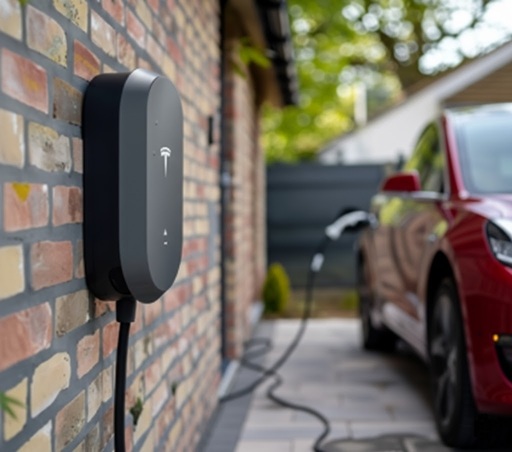
Exterior wall mount (outdoor-rated, weatherproof) $1,800 – $2,800
Detached garage (underground conduit trenching, 20–60 ft) $2,500 – $5,000
Panel upgrade (100A to 200A) + Level 2 install $3,500 – $6,500
Rural property — long trench, sub-panel at outbuilding $4,500 – $8,000+
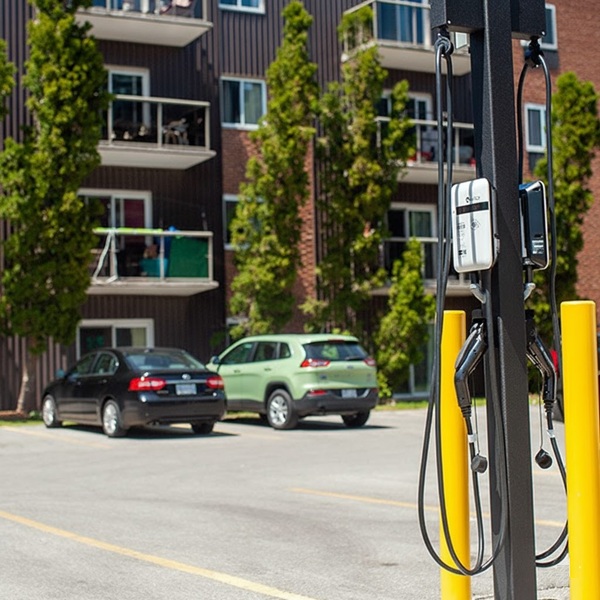
Condo / MURB installation (dedicated circuit, shared parking) Custom Quote Required
Two-EV household with load-sharing setup $2,800 – $4,500

What Drives the Price Up or Down

Five variables account for most of the cost difference between a $1,400 install and a $4,500 one. None of them are surprises once you understand them — and knowing them upfront puts you in a position to get a meaningful first quote rather than a range that adjusts after the site visit.

1. Panel Capacity and Condition

A dedicated Level 2 charger circuit requires 40 to 50 amps. If your panel is 200 amps with available breaker slots, the charger goes in cleanly. If your panel is 100 amps — common in Ontario homes built before 1980 in Hamilton, Kitchener, Barrie, and older GTA neighbourhoods — a panel upgrade is required before the charger can be safely added. That upgrade runs $2,000 to $3,500 on its own, and it must be coordinated with your local utility (Hydro One, Toronto Hydro, Alectra, or a local municipal utility). An Electric Vehicle Energy Management System (EVEMS) can sometimes avoid a full panel upgrade by intelligently limiting charger draw when household load is high — worth asking about if your panel is borderline.

2. Distance from Panel to Charger Location

Wire cost and labour time both scale with distance. A 10-foot run through open framing is straightforward. A 40-foot run through a finished basement ceiling, around a furnace room, through an exterior wall, and into an attached garage adds both materials and time. A run to a detached garage or backyard structure involves underground conduit, which adds trenching, conduit, weatherproof junction boxes, and often a sub-panel at the destination. Even a rough estimate of panel-to-charger distance changes your quote meaningfully — include it when requesting bids.

3. Wall and Building Construction

Open framing in a new build or unfinished garage is the easiest routing environment. Finished drywall adds modest complexity. Masonry (brick, concrete block, or stone) requires core drilling and adds $200 to $500 depending on wall thickness and number of penetrations. Heritage properties, particularly in downtown cores of cities like Hamilton, Kitchener, and Toronto, may have restrictions on exterior modifications that affect routing options.

4. Indoor vs. Outdoor Installation

Indoor garage installs use standard equipment and straightforward conduit. Outdoor installs require weather-rated chargers (minimum NEMA 3R, ideally NEMA 4), weatherproof junction boxes, drip loops at connections, GFCI protection at the breaker, and conduit rated for outdoor exposure. Ontario winters are hard on equipment — proper weatherproofing at installation time prevents connector failures and freeze-related service calls. Budget an additional $200 to $500 for a properly executed outdoor install compared to an indoor equivalent.

5. Municipality and Utility Territory

Electrician hourly rates vary across Ontario. Urban GTA rates typically run $100 to $140 per hour for licensed residential electrical work. Smaller cities and towns — Barrie, Kitchener, Hamilton, Kingston — tend to run $90 to $125. Permit timelines also vary: Hydro One service upgrades in rural areas can take four to eight weeks, while Toronto Hydro and Alectra typically move faster. Knowing your utility territory before requesting quotes helps set realistic timeline expectations.

Ontario EV Charger Rebates and Incentives (2025)

Rebate availability in Ontario changes frequently as funding programs open, close, and reopen. The following reflects the landscape as of 2025, but confirm current status directly before planning your budget around any specific program.

Program Who It Covers Potential Value
Canada Greener Homes Grant (federal) Homeowners (income-tested in some streams) Up to $5,000
ZEVIP — Zero Emission Vehicle Infrastructure Program Workplaces, MURBs, fleets 50% of eligible costs
Ontario ChargeON Program Public, municipal, and workplace charging Up to 75% of costs
Utility Time-of-Use Off-Peak Rates All Ontario EV owners charging overnight $1,500 – $3,000/yr in fuel savings

The most reliable and consistent savings for Ontario homeowners is not a rebate program at all — it is the time-of-use rate structure. Charging overnight during off-peak hours (typically 7 p.m. to 7 a.m. on weekdays, all day on weekends) costs approximately 8 to 12 cents per kilowatt-hour depending on your utility. At that rate, driving 20,000 kilometres per year costs roughly $300 to $500 in home charging electricity — compared to $2,400 to $2,800 in gasoline at current prices. A smart charger that automatically delays charging until off-peak hours pays for its premium over a basic unit within one to two years.

How to Get an Accurate Quote

The single biggest source of quote inaccuracy is insufficient information at the time of request. Installers who quote without seeing your panel and routing options build in a buffer for unknowns — which inflates the estimate. Four pieces of information eliminate most of that buffer before anyone arrives on site.

  • A photo of your electrical panel with the door open, showing the main breaker rating, all breakers, and available slots. This one image lets a licensed electrician assess capacity, manufacturer compatibility, and available circuit positions without a site visit.
  • A photo of your regular parking spot or the wall where the charger will mount, including as much of the path back to the house as visible.
  • A rough distance estimate from the panel to the charger location — even “about 25 feet through one finished wall” is more useful than nothing.
  • Your EV make and model, since onboard charger capacity varies (some vehicles max at 32 amps, others at 48 amps) and determines the correct circuit size for your installation.

With that information, a reputable Ontario electrician provides a firm total cost rather than a wide range — and flags any likely complications before installation day rather than after.

Finding the right installer shouldn’t be complicated. EV Quotes connects Ontario homeowners with verified electrical contractors so you can compare pricing, timelines, and installation options with confidence. Submit your details once and receive competitive quotes from qualified professionals — no pressure, no guesswork, just transparent options tailored to your home.
Submit your project details and receive up to 3 quotes from verified EV charger installers in your area—within hours. 

Click on your city below to find a trusted EV charger installer near you.

EV Charger Types

1.0

Level 1 EV Charger Installation

Learn about Level 1 EV chargers in Canada — how they work, charging speed, cost, and when to use them.

Read more arrow
2.0

Level 2 EV Charger Installation

Understand Level 2 EV chargers in Canada — what they do, how fast they charge, what they cost, and why they’re worth it.

Read more arrow
3.0

Level 3 EV Charger Installation

Explore Level 3 EV chargers in Canada — high-speed solutions ideal for businesses, fleets, and multi-unit properties.

Read more arrow
4.0

Permits, Safety, & Best Practices

Your essentials on EV charger permits, inspection requirements, and safety tips to guarantee a reliable, code-compliant installation.

Read more arrow

EV Charger Installation Services

Test

Residential EV Chargers

Learn what’s involved in installing a home EV charger — from assessing your electrical panel and running new wiring to obtaining permits and ensuring code compliance. Understand how professional installation makes charging safer, faster, and more reliable.

Read more arrow

Commercial EV Chargers

Discover how commercial EV charger installations are planned and executed, including site design, electrical capacity upgrades, and equipment selection. Learn how businesses can meet growing EV demand while offering secure, high-speed charging for employees and customers.

Read more arrow

Condo EV Chargers

Find out how EV charging works in condominium settings — from navigating approvals with condo boards to sharing electrical infrastructure. Learn about metering options, load management, and the steps needed to bring charging access to every resident.

Read more arrow

Multi Unit EV Chargers

Explore how multi-unit EV charger installations are designed for scalability and efficiency. Understand how electricians balance power loads, set up smart billing systems, and future-proof electrical capacity for expanding EV adoption.

Read more arrow

Ontario EV Industry News

Ontario EV Registrations: BEV & PHEV Statistics for 2025

2025 Ontario EV Registrations by Region Ontario registered 40,186 electric vehicles in 2025, with battery electric vehicles commanding a decisive 64.3% share of the provincial EV market. Quarterly registrations showed …

Read more arrow

Ontario BEV & PHEV Registration Statistics for 2024

2024 Ontario EV Registrations by Region Ontario registered 57,648 electric vehicles in 2024, with battery electric vehicles commanding a decisive 70.8% share of the provincial EV market. The year saw …

Read more arrow

Ontario BEV & PHEV Registration Statistics for 2023

2023 Ontario EV Registrations by Region Ontario registered 46,704 electric vehicles in 2023, with battery-electric models dominating the market at nearly four times the volume of plug-in hybrids. Central Ontario …

Read more arrow

Your Complete Guide to Level 2 EV Chargers in Canada

If you’ve recently purchased an electric vehicle in Canada, you're likely enjoying the convenience of waking up to a full battery. While the basic Level 1 charger that came with …

Read more arrow

Frequently Asked Questions

An EV charger supplies electricity to recharge an electric vehicle’s battery at home or in public places.

There are three main types: Level 1 – Standard wall outlet (slow) Level 2 – Home/Public charger (medium) DC Fast Charger – Highway stations (very fast)

For faster charging, most people install a Level 2 home charger and may need electrical upgrades.

Most EVs can use standard chargers, but some (like Tesla) may need adapters for certain stations.

In Ontario, a complete EV charger installation typically ranges from $2,000 to over $4,500. This includes the cost of the Level 2 charging unit, ESA permit fees, materials, and electrician labor. Factors like upgrading your electrical panel or running long wires from the panel to the garage will influence the final installation cost.

Absolutely. While Level 1 chargers are free, they are incredibly slow. A Level 2 charger is an investment in convenience, offering charging speeds up to 10 times faster. This ensures you wake up to a full battery every morning, eliminating range anxiety and maximizing your EV ownership experience for years to come.

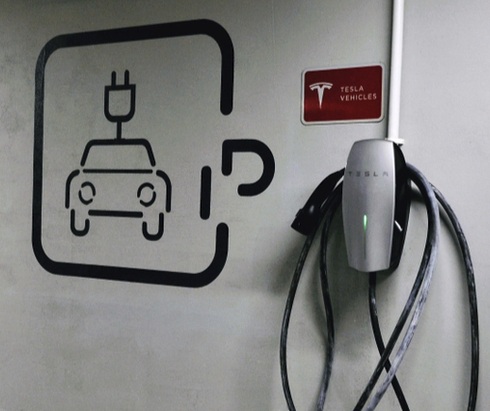
Installing a Tesla Wall Connector generally costs between $700 and $3,500 for the labor and materials, depending on complexity. If you need a panel upgrade or extensive wiring, costs will be on the higher end. Always hire a Licensed Electrical Contractor to ensure your Tesla is charged safely and efficiently.

Yes, significantly. Charging an EV at home is much cheaper than refueling a gas car. In Ontario, using ultra-low overnight electricity rates can cost merely pennies per kilowatt-hour. Most EV owners save hundreds, if not thousands, of dollars annually on fuel costs compared to driving an internal combustion engine vehicle.

Your electric bill will increase because you are consuming more electricity, but this is offset by the elimination of gas costs. Charging a Tesla is highly efficient; for the average driver, the monthly increase in electricity is a fraction of what they previously spent at the gas pump.

While the main provincial EV charger rebate program in Ontario has concluded, it's worth noting past initiatives like the EV ChargeON Program. This program was designed to support the installation of public EV charging stations across Ontario communities, helping to reduce range anxiety and improve long-distance EV travel. It offered rebates covering 25–75% of eligible expenses after construction. The application period for this program ran from November 3, 2025, to January 15, 2026, and it is not currently accepting new applications.


For the most current financial support options, you should check for any federal incentives or specific offers from your local utility provider. Visiting federal government websites and contacting your local utility are the best ways to get up-to-date information.

Generally, no. While some vehicle manufacturers might include a basic Level 1 charging cable with your car purchase, high-speed Level 2 home chargers are separate purchases. Occasionally, dealerships or local utilities run promotions, but you should budget for purchasing hardware and professional installation.

Yes, installing a Level 2 EV charger can increase your property's appeal and value. As EV adoption grows, home buyers increasingly view a pre-installed, permitted charging station as a premium convenience feature, saving them the hassle and cost of installing one themselves after moving in.

Yes, an electrical permit (notification) from the Electrical Safety Authority (ESA) is mandatory for installing an EV charging station in Ontario. This ensures the installation meets the Ontario Electrical Safety Code. Once the work is complete, your installer should provide you with an ESA Certificate of Acceptance.

While any Licensed Electrical Contractor can technically perform the work, it is highly recommended to hire an electrician with specific EV installation experience. They will be familiar with load calculations, specific EV code requirements, and how to optimize your setup for your specific vehicle and home electrical system.

No, DIY installation of Level 2 chargers is strongly discouraged and often dangerous. In Ontario, working with high-voltage electrical systems requires a Licensed Electrical Contractor to ensure safety and code compliance. Improper installation can void your home insurance, damage your vehicle's battery, and pose serious fire risks.

The "80% rule" in the Canadian Electrical Code dictates that a continuous load, like an EV charger, cannot exceed 80% of the circuit's rating. For example, if you install a 40-amp charger, it requires a 50-amp breaker. This safety margin prevents the circuit breaker from overheating during long charging sessions.

Most modern homes with 200-amp service can easily handle a Level 2 charger. However, older homes with 100-amp service might require a "Load Calculation" by an electrician. If your panel is at capacity, you may need a panel upgrade or a Load Management System (EVEMS) to charge safely.

Not always. While upgrading to 200 Amps is a robust solution, it can be expensive. An alternative is an Electric Vehicle Energy Management System (EVEMS). This smart device monitors your home's energy use and temporarily lowers the charger's power if other appliances (like a dryer) are running, avoiding a full panel upgrade.

The breaker size depends on the amperage of your charger. Following the 80% continuous load rule, a 32-amp charger needs a 40-amp breaker, while a 48-amp charger requires a 60-amp breaker. Your electrician will determine the correct wire and breaker size to ensure your system runs cool and safely.

Installing a NEMA 14-50 (240V) outlet typically costs between $700 and $2,000. This price varies based on the distance from your panel and if a new circuit breaker is needed. This outlet allows you to use a plug-in Level 2 charger, offering flexibility if you move.

Technically, yes, if it is a 240V outlet. However, you should not constantly unplug your dryer to plug in your car, as these outlets aren't designed for frequent use. A better solution is a "smart splitter" device or installing a dedicated circuit for the car to ensure safety and convenience.

Hardwired units are generally preferred for Ontario. They are more weather-resistant for outdoor installs, have fewer connection points (reducing failure risk), and can often charge at higher speeds. Plug-in units offer portability but require an expensive GFCI breaker and are less secure against theft or tampering.

Yes, you can, but the process involves several steps. Unlike new buildings, Ontario does not have a province-wide "EV-ready" mandate for existing condos. However, the Condominium Act (O. Reg. 48/01) provides a clear legal framework to guide these installations.

For board-initiated installations, if the cost is less than 10% of the annual budget, the condo board can move forward without a vote after providing a 60-day notice to owners.

For owner-initiated installations, you’ll need to submit an application to your condo board. The board must respond within 60 days and can only deny the request for specific reasons, such as safety concerns or structural limitations. If approved, an agreement must be signed between the owner and the condo corporation, which is then registered on the unit's title.

To ensure the building has enough electrical capacity for a new EV charger, a load analysis will likely be required for your condo EV installation. You must also hire a Licensed Electrical Contractor for the work. While Ontario regulations have streamlined the process, following these steps carefully is essential for compliance.

This is a critical document issued by the Electrical Safety Authority in Ontario. It proves that your EV charger installation has passed inspection and meets the Ontario Electrical Safety Code. You should always ask your electrician for this certificate; it protects your home insurance and resale value.

Yes, provided you choose a unit rated for outdoor use (NEMA 4 or 4X rating). These chargers are sealed against rain, snow, and ice. Your installer will also need to use weather-rated cabling and conduit to ensure the system withstands harsh Canadian winters without safety issues.

Level 2 charging is significantly faster. While a Level 1 EV charger (standard wall outlet) adds about 6-8 km of range per hour, a Level 2 EV charger adds 30-50 km per hour. This means a Level 1 might take 20+ hours to fill a battery, whereas a Level 2 takes just 4-8 hours.

The 80/20 rule suggests keeping your EV battery charge between 20% and 80% for daily driving. Avoiding charging to 100% or draining to 0% regularly helps prolong the battery's lifespan. Most EVs allow you to set a "charge limit" to stop automatically at 80% or 90%.

Yes. Home charging is the primary benefit of EV ownership. It offers unparalleled convenience. You essentially start every day with a "full tank." It is also the most cost-effective way to power your car compared to using expensive public fast chargers or relying on gasoline.

A high-quality, reputable Level 2 EV charger typically lasts about 10 years. Longevity depends on the build quality, whether it is installed indoors or outdoors, and usage frequency. Modular units with replaceable cables can often be repaired rather than replaced if wear occurs.

A standard installation usually takes between 2 to 4 hours. However, if your project is complex, requiring a panel upgrade, trenching for underground wires, or running conduit across a finished basement, it could take a full day. Your electrician can give you a precise timeline during the quote.

The NEMA 14-50 is a standard 240-volt electrical outlet, commonly used for electric ranges and RVs. It is the most common outlet type for plug-in Level 2 EV chargers. If you choose a plug-in charger, this is likely the outlet your electrician will install.

If you own a Tesla, the Wall Connector is seamless and offers the fastest charging. However, if you plan to own non-Tesla EVs in the future, a universal charger with a J1772 connector (or Tesla's new Universal Wall Connector with an adapter) offers more flexibility for charging different vehicle brands.

The best time to charge is usually overnight, specifically during "Ultra-Low Overnight" price periods if you are on a Time-of-Use (TOU) plan. Many Ontario utilities offer significantly lower rates between 11 PM and 7 AM, allowing you to charge your vehicle for a fraction of the peak-time cost.

A Load Management System (or EVEMS) allows you to install a charger even if your electrical panel is "full." It monitors your home's power usage in real-time. If you turn on the stove and dryer, it temporarily reduces power to the car charger to prevent blowing the main fuse.